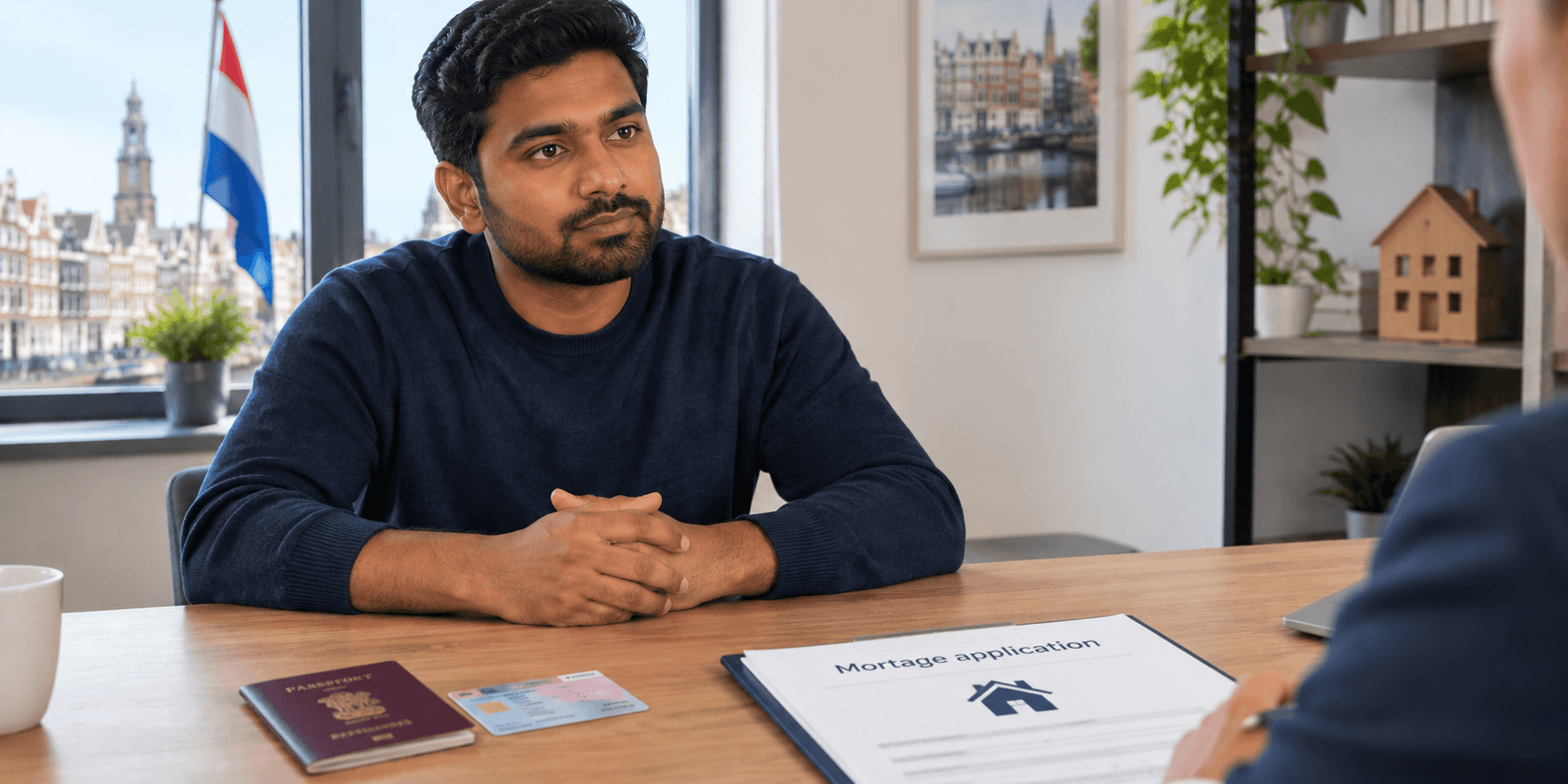

Is It Difficult to Get a Mortgage in the Netherlands?
Whether getting a mortgage in the Netherlands is difficult depends largely on your individual circumstances. For some people, the process is relatively straightforward. For others, it requires more effort and the right guidance. Here is an honest look at what to expect.
The basic requirements
To qualify for a mortgage in the Netherlands, you generally need:
- A valid passport or ID — This is the most basic requirement for any financial transaction.
- A BSN (Burgerservicenummer) — Your Dutch citizen service number, obtained when you register at your local municipality.
- Proof of income — For employees, this typically means your employment contract, recent pay slips, and an employer's statement (werkgeversverklaring).
- Three years of tax returns — If you are self-employed (ZZP'er), lenders want to see at least three years of financial history. Some lenders accept one or two years, but options are more limited.
- Six or more months of residency — Many lenders prefer applicants who have lived in the Netherlands for at least 6 months. Some are more flexible, while others may require 2 to 5 years.
Challenges for specific groups
While the basic process is accessible, certain groups may face additional hurdles:
Self-employed professionals (ZZP'ers) If you are self-employed, lenders assess your income differently. They typically look at the average profit over your last three financial years. If your income fluctuates significantly, lenders may use the lowest year or apply a conservative estimate. Having a solid track record and clean financial statements makes a significant difference.
Non-EU nationals If you are from outside the EU, additional requirements may apply. You need a valid residence permit, and some lenders restrict the maximum Loan to Value to 80% for applicants with less than 2 years of residency. The type of residence permit also matters: a highly skilled migrant permit is viewed more favorably than a temporary permit.
Temporary contract holders If you do not have a permanent employment contract, some lenders may be hesitant. However, many lenders accept temporary contracts, especially if your employer provides an intention statement (intentieverklaring) indicating the contract is likely to be extended or made permanent.
International organization employees Working for organizations like the ICC, Europol, or NATO comes with special tax considerations. Since you may not pay Dutch income tax, the standard mortgage interest deduction does not apply, and not all lenders are equipped to handle these cases.
Each bank has its own criteria
One of the most important things to understand about the Dutch mortgage market is that each lender has its own criteria. What one bank rejects, another may accept. This applies to income assessment, residency requirements, property types, and even which nationalities they serve. The differences can be substantial.
Access to 30+ lenders helps
This is where an independent mortgage advisor makes a real difference. Rather than approaching one or two banks and hoping for the best, an advisor has access to more than 30 active lenders in the Dutch market. They know which lenders are most flexible for your specific situation and can direct your application to where it has the best chance of success.
For example, if you are a ZZP'er with two years of history, your advisor knows which three or four lenders will assess your application most favorably. If you are a non-EU national who arrived six months ago, they know which lenders do not require a minimum residency period.
The process itself
The mortgage application process in the Netherlands is well-structured and generally takes 4 to 8 weeks from application to completion. The steps are:
- Initial consultation and pre-qualification
- House hunting and making an offer
- Formal mortgage application with all documents
- Lender assessment and approval (typically 1-2 weeks)
- Mortgage offer issuance
- Signing at the notary
Conclusion
Is it difficult to get a mortgage in the Netherlands? For many people, it is not, especially with the right guidance. The key factors are having a stable income, meeting the residency requirements, and working with an advisor who can match you with the right lender. Even in more complex situations, solutions are usually available. Contact us for a free consultation to assess your specific situation.
Buying in The Hague? Read everything about an expat mortgage in The Hague, or book a free first meeting.